Turnitin and Canvas

In this workshop, we showed participants how to use Turnitin’s “Plagiarism Framework” integration with Canvas. This new integration allows the tools to work together more closely and efficiently. Turnitin is a plagiarism-prevention tool that helps you check the academic integrity of student writing. Specifically, we looked at:
-
- enabling Turnitin assignments within the existing Canvas assignment workflow,
- accessing Turnitin’s plagiarism checking via the Canvas SpeedGrader,
- grading and providing feedback on Turnitin submissions within the Canvas SpeedGrader, and
- viewing Turnitin’s potential plagiarism indicators directly in the Canvas Gradebook.
Session Date:
Thursday, June 27 | 12:00 pm – 1:00 pm
Facilitators:
Eduardo Rebagliati and Kalisa Young
Recording
- 00:02 🎓 Introduction and Acknowledgement
- Opening the workshop and introducing presenters,
- Acknowledging the traditional lands of the Indigenous Nations,
- Overview of the agenda for the workshop.
- 00:52 🌐 Importance of Accessible Meetings
- Explaining the importance of understanding in meetings,
- Accessibility’s benefit to those with disabilities and non-native speakers,
- Legal obligations and opportunities for creating accessible resources.
- 04:25 🧩 Zoom’s Accessibility Features Introduction
- Overview of Zoom’s features such as captioning and transcripts,
- Previews of recording options to create accessible content.
- 05:44 ✨ Demonstrating Zoom’s Captioning and Transcript
- How to enable captions and alter their settings for accessibility,
- Explanation of transcripts and their usage in meetings.
- 10:19 📁 Recording Configurations in Zoom
- How to configure recordings on Zoom for different views,
- Explanation of creating audio files for individual participants.
- 14:12 🎥 Using Recordings for Accessible Resources
- Introduction to editing recordings for better accessibility,
- Explanation of post-production improvements for educational resources.
- 20:34 🚀 Recommended Accessibility Practices
- Spotlighting and pinning features for interpreters,
- Importance of accessible chat practices and sharing resources.
- 24:01 📊 Accessibility of Zoom Features
- Discussion around the accessibility of Zoom polls and navigation with screen readers.
- Emphasis on using Zoom polls thoughtfully and providing alternatives, such as open discussions.
- Challenges with the accessibility of Zoom Whiteboard and recommendations for using alternative tools or explaining actions during sessions.
- 26:48 📅 Upcoming Workshops and Events
- Announcement of upcoming workshops and events, including sessions on alternative assessments and AI tools.
- Promotion of the Climate Justice InFocus themed discussions.
- Invitation to check their website, join the mailing list, and follow LinkedIn for updates and information.
- 29:18 📢 Q&A and Support Availability
- Invitation for participants to ask questions and reach out for further support.
- Encouragement for attendees to contact them via email for any needed assistance.
- Concluding remarks and appreciation for attendees’ participation in the workshop.
An Inter-Institutional Action on Climate Change: Voices for Environmental Change in Policy and Economics

This interactive Viewpoint session was an extension of our collaborative podcast series titled An Inter-Institutional Action on Climate Change, where thought leaders in social institutions engaged in dialogue to discover transformative learning opportunities to address climate change.
In this session, Dr. Patrick Baylis, Assistant Professor and Environmental Economist, UBC, and Michael Wolfe, Richmond City Council shared their leadership experience in environmental education and public responses to climate change in their respective fields.
This event was hosted in collaboration with the Edith Lando Virtual Learning Centre.
Session Date:
Tuesday, June 25 | 12:00 pm – 1:00 pm
Panel (click/tap on name to see bio):
Patrick is an assistant professor and environmental economist at the University of British Columbia (UBC). He studies how people respond to environmental threats like climate change, air pollution, and wildfires, and how public policies might help them respond better.
Michael Wolfe is currently serving his second term on Richmond City Council, where he is the leading voice for climate justice in city policies. He has also been a senior science teacher and pressures the Richmond School District to step up their leadership in environmental education. He completed his B.Sc., B.Ed., and M.Ed. at UBC and has two young children.
Recording
Tea with AI

Designing and setting up inclusive content can be challenging. During candid conversation on Inclusive Content and AI, we discussed whether AI can be a helping hand in this process. We also discussed ways that students can use AI tools to interact with the course content in a more inclusive way.
Session Date:
Tuesday, June 25 | 12:00 pm – 1:00 pm
Facilitators:
The LDDI Team
Learning Technology Orientation for KIN HPCTL

In this workshop, we introduced students from the High Performance Coaching and Technical Leadership (HPCTL) masters program at the School of Kinesiology (KIN) to learning technologies used at UBC, such as Canvas, UBC Blogs, and Camtasia. The workshop included various hands-on activities to get students started right in their UBC journey.
Session Date:
Monday, June 10 | 9:30am – 11:00am
Facilitators:
The LDDI Learning Technology Team
Indigenous Art & Sustainability: Hands-on Beaded Earring Workshop

Cheyenne provided a unique and authentic learning opportunity for participants to gain a greater awareness of Indigenous people’s connections with beadwork, food, and nature. A BBQ Salmon lunch and all beading materials were provided. The workshop was limited to 20 participants. The meeting took place in the Neville Scarfe Building, room 1008. Participants were reminded not to forget their sunscreen and a hat!
The intention behind the hands-on workshop was to repurpose salmon vertebrae into beads. Cheyenne began this work in 2022 as part of a composting pedagogies project for an environmental literacy class. Indigenous people across Turtle Island have practiced sustainable food harvesting since time immemorial – using fish weirs, dip nets, and gill nets. In British Columbia, the Pacific salmon were a cultural keystone species and a significant food source for Indigenous people. The salmon egg represented the core, the symbology of the life cycle of Pacific salmon. Additionally, “the understandings and philosophies embedded with this centre were carried through time and across generations, through language, story, ceremony, practice, and law” (Living Planet Report, 2022, p. 51). The salmon vertebrae beads used in each of the earrings were Cheyenne’s rendition of her understanding of language, story, and practice.
About the Artist:
ʔə́y̓ swéyəl mək̓ʷ wet Cheyenne Cunningham θə nə skʷix təni cən ʔəƛ̓ q̓íc̓əy̓. Good day everyone, my name is Cheyenne Cunningham and I currently reside on the Katzie First Nation reserve located along the Fraser River in Pitt Meadows, BC. I am English on my mother’s side and Coast Salish on my father’s side. I am in my third year of my PhD in Language & Literacy Education at UBC. I also recently graduated from SFU with my Diploma in Indigenous Language Proficiency. My research interests focus on the exploration of Katzie place names that have been identified in Suttles (1955) Katzie Ethnographic Notes, to surface knowledge embedded within these landscapes. I would like to examine how these place names can contribute to language revitalization initiatives.
Session Date:
Tuesday, May 28 | 12pm – 2pm
Tea With AI

In this Tea With AI we looked at the BC Ministry of Education’s guidance on Digital literacy and the Use of AI in Education. Additionally, we explored two AI tools: Diffit for Teachers, and MagicSchool.
Location:
Neville Scarfe, Room 1008
Facilitators:
The LDDI Team
LDDI Games Club

The Faculty of Education hosted its monthly event where faculty, staff, and students were encouraged to bring their own games or join existing ones. It was a delightful occasion for friendly competition and connecting with fabulous individuals.
A Workshop for BEd Instructors: Getting in Sync With Your Digital Classroom

This workshop offered evidence-based practices and pedagogical methods for your online hybrid course designs. This workshop guided you through your decision-making, informed your teaching choices, and supported you in identifying priorities in online learning spaces. You learned practical strategies on how to organize, present, pace, and structure your course to enhance student learning and engagement. We showcased and provided examples of tools for individual and collaborative online activities in hybrid learning modes, considering inclusivity, diversity, and digital wellness in everyday teaching and learning.
Facilitators:
Gabrielle Coombs
Kalisa Young
Jamilee Baroud
Orientation to Learning Technologies for Instructors
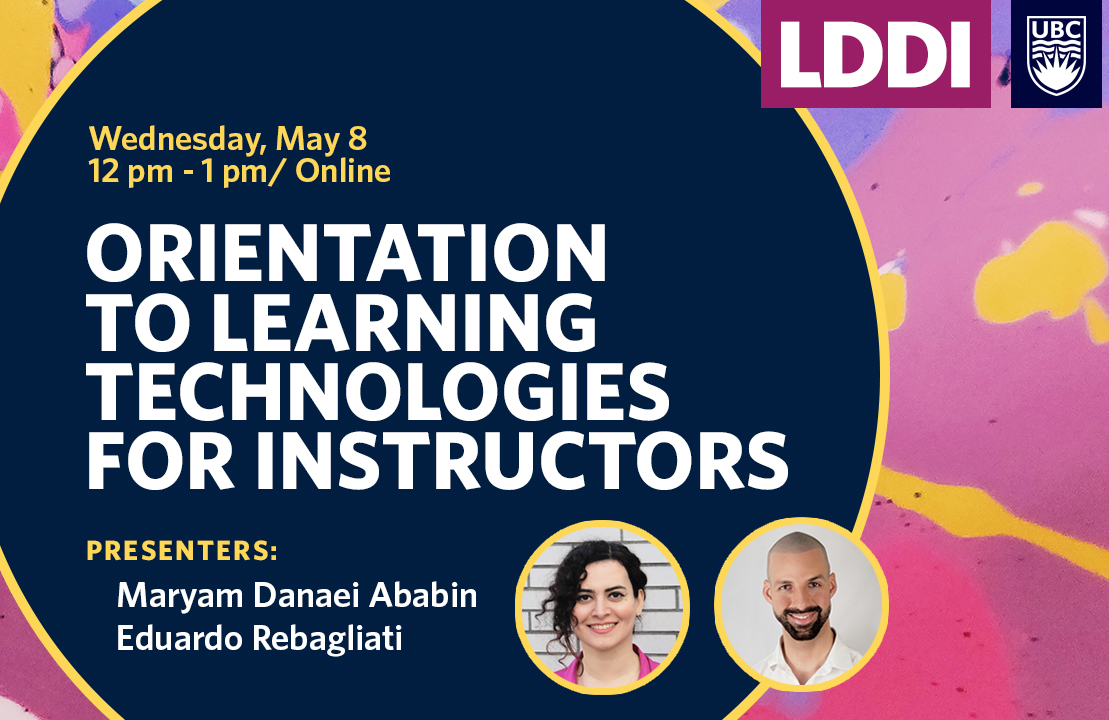
In this orientation workshop for new Faculty of Education instructors, we explored the services and learning technologies available at UBC. We looked into how technology can be used to improve your teaching experience, and how to find support if you need it. This session covered:
- Overview of UBC Learning Technology Ecosystem
- UBC Technologies
- UBC Technology Services
- Intro to the Canvas LMS
Facilitators: Maryam Danaei Ababin and Eduardo Rebagliati